Mandatory before 1 July 2027
VeriFactu is here. Your invoicing, ready
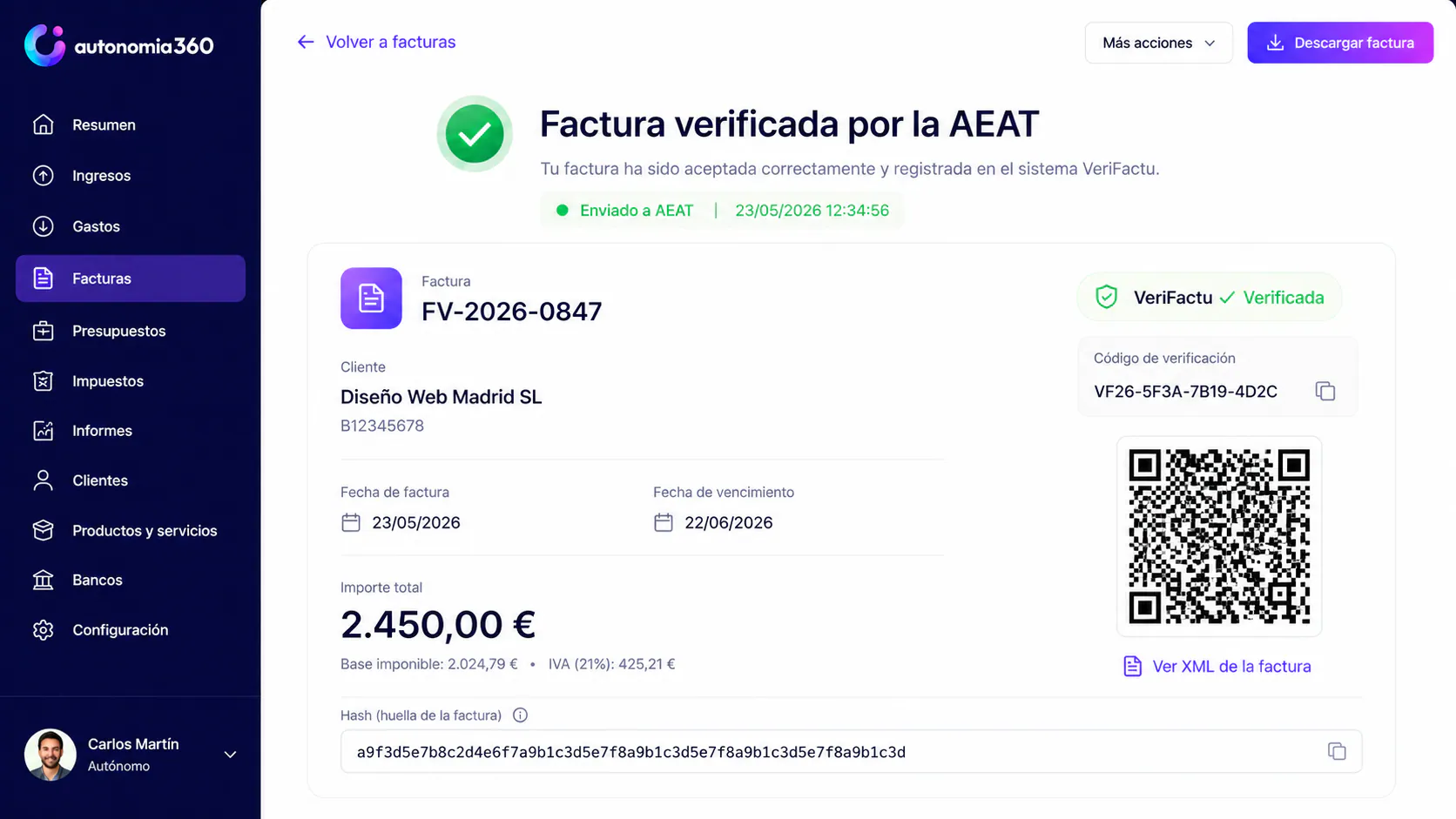
Before 1 July 2027 any software you use to issue invoices must comply with VeriFactu (1 January 2027 if you pay Corporate Income Tax). autonomia360 already does: your invoices carry a chained record, a verifiable QR code and automatic submission to the AEAT in VERI*FACTU mode, without you doing a thing.
What the rule requires
What changes with VeriFactu
The VeriFactu Regulation (Royal Decree 1007/2023) sets four technical requirements that any invoicing software must meet. The adaptation deadlines, extended by Royal Decree-Law 15/2025, are 1 January 2027 for Corporate Income Tax payers and 1 July 2027 for everyone else, freelancers included.
Certified invoicing software
If you issue your invoices with software, it has to meet the technical requirements of the VeriFactu Regulation: record integrity, traceability and tamper-proofing.
Chained record of every invoice
Each invoice generates a record with a digital fingerprint chained to the previous one. That makes it impossible to alter or delete an invoice without the Spanish Tax Agency spotting it.
QR code on every invoice
Invoices include a QR code that lets the recipient verify the document directly with the AEAT. Proof of authenticity in real time.
Reporting to the AEAT: voluntary or mandatory
The Regulation allows two modes: VERI*FACTU (automatic submission of records to the AEAT) and NON-VERI*FACTU (keeping the records with the required technical safeguards, without submission). autonomia360 operates in VERI*FACTU mode.
Before and after
What's no longer valid and what replaces it
Frequently asked questions about VeriFactu
What exactly is VeriFactu?
VeriFactu is the verifiable-invoicing system introduced by the Spanish Tax Agency (AEAT) under the Anti-Fraud Law (Law 11/2021) and Royal Decree 1007/2023. It requires invoicing software that guarantees records cannot be altered or deleted, and that every invoice carries a chained digital fingerprint.
From when is it mandatory for freelancers?
Royal Decree-Law 15/2025 extended the original deadlines: Corporate Income Tax payers must have their systems adapted before 1 January 2027, and everyone else — including, as a rule, freelancers — before 1 July 2027. The AEAT has published a note confirming the new deadlines.
Is VeriFactu the same as TicketBAI?
No. TicketBAI is the equivalent system in the Basque Country and Navarre (Spain's foral tax territories) and has its own technical specifications. VeriFactu applies to the rest of Spain, and in some regions it is being rolled out in phases. Our free tool tells you what applies where you are.
What happens if I keep using Excel or Word to invoice?
The rules govern invoicing software: they don't force you to use one, but if you do it must be adapted to the Regulation, and invoicing with non-compliant software can lead to penalties for both the software maker and the person using it. The easiest way to comply is to invoice with a platform that's already adapted.
Does autonomia360 already comply with VeriFactu?
Yes. autonomia360 has had VeriFactu-compliant invoicing built into its architecture from the start. Your invoices are issued with the technical requirements covered — chained record, verifiable QR code and reporting to the AEAT — without you doing anything special.
Do I need to do anything to adapt?
If you invoice with autonomia360, nothing. If you use other software, ask your provider whether it's already adapted to the Regulation or when it will be. The general deadline is 1 July 2027 and the technical changes are far from trivial.
Comply with VeriFactu without thinking about VeriFactu
Invoice with autonomia360 and forget the small print. Everything included from day one.